

DAVIDSON PRIZE FINALIST 2025
Positive Disturbance
A new approach to brownfield housing at Clasper Village, Gateshead, working with existing soils, habitats and community life to create a neighbourhood that can grow and evolve.

01 / THE PROJECT
Positive Disturbance asks how new homes can become part of an established brownfield ecology rather than replace it. Developed for the 2025 Davidson Prize, the project uses the six-hectare former Clasper Village on Gateshead’s riverside to challenge the conventional cycle of clearance, remediation and redevelopment. Instead, housing is grafted into a landscape already shaped by industry, abandonment, human activity and natural succession. Soil, vegetation, wildlife and existing patterns of use become the starting point for a neighbourhood that can continue to evolve.
02 / DESIGN EXPLORATION
Pioneer
Brownfield is often understood as land waiting to be regenerated. Positive Disturbance begins from the opposite position: Clasper Village has already regenerated itself. Former development platforms have become ephemeral wetlands, pioneer vegetation has matured and a mosaic of habitats has established across disturbed soils. At the same time, the site remains part of a wider human landscape of informal routes, foraging, activism and memory. The proposal asks how the urgent need for new homes might work with this existing complexity rather than erase it.
Working collaboratively across landscape, architecture, art, engineering and research, the team explored housing itself as a form of positive disturbance: recognising that intervention brings change, but asking how that change might increase the long-term ecological, social and spatial vitality of a place. The approach responds directly to the difficult relationship between brownfield housing policy and the ecological value that can emerge on previously developed sites.

Root
The proposal starts beneath our feet. Research with Karen Johnson, Professor in Environmental Engineering at Durham University, informed a soil-first approach that questions the conventional excavation and disposal of contaminated ground. Early soil mapping, in-situ treatment, phytoremediation and planting become part of a longer process of repair, allowing development and environmental recovery to happen together.
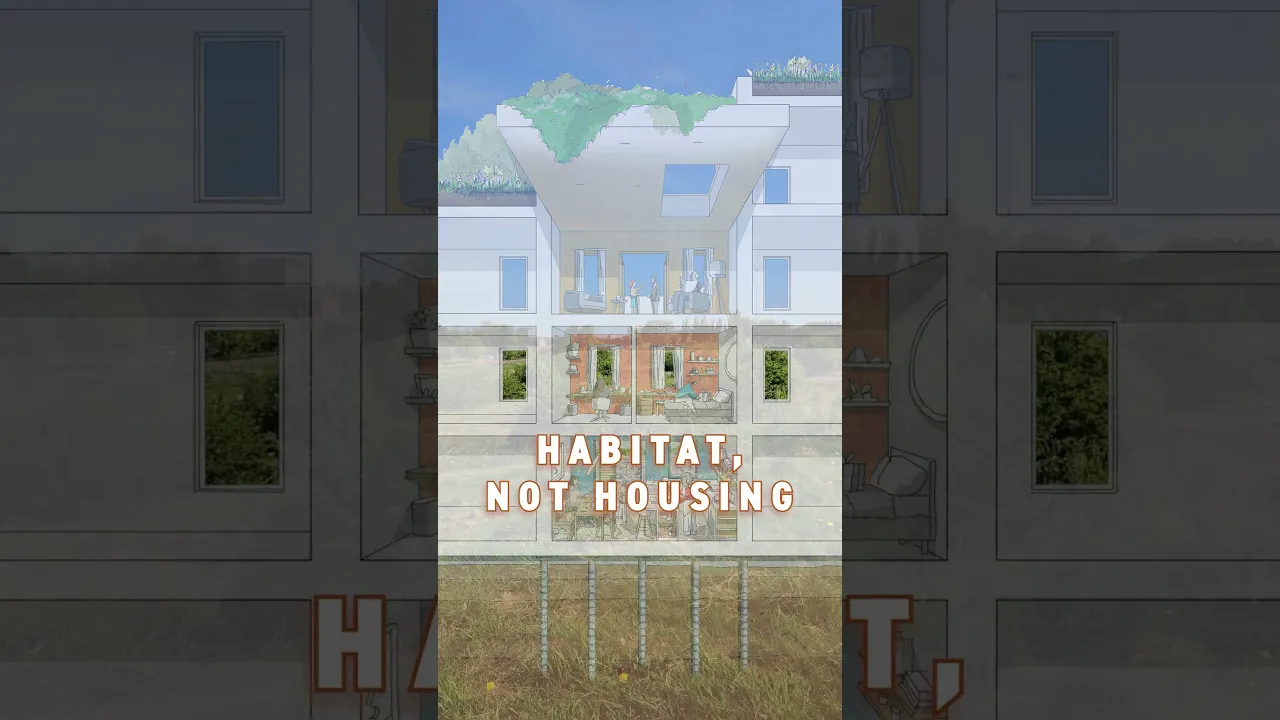
Above ground, the existing landscape establishes the structure of the neighbourhood. A mature sentinel tree becomes the focus of a courtyard; established foraging routes weave through new housing; and ephemeral wetlands become rain gardens and natural drainage infrastructure. Lightweight construction and screw-pile foundations allow buildings to touch the ground more lightly, while landscape, public realm and housing are conceived as a single interdependent system rather than separate layers.
Adapt
Positive Disturbance proposes a neighbourhood that is never entirely finished. Landscape remediation begins before construction, making productive use of the years between site acquisition and delivery, while planting, soil and habitat continue to develop as homes arrive. Adaptable timber-frame housing allows individual homes to change over time, alongside diverse tenures and intergenerational forms of living.
The result is an approach to brownfield development based on stewardship rather than clearance. Human occupation becomes the next disturbance in Clasper’s continuing history, joining rather than resetting the processes already underway. What emerges is a framework in which homes, landscapes and human and more-than-human communities can grow together, offering principles that could extend beyond Clasper to brownfield sites elsewhere.
Project team
The finalist team brought together FLOC, MAZi Architects, Hyem Landscape, Stef Leach, Broaden, Thurston Illustration, SHED, Artis and artist Henna Asikainen.
Project films
LET’S MAKE ROOM FOR SOMETHING GOOD.
Hyem Landscape
Landscape architecture / © 2026